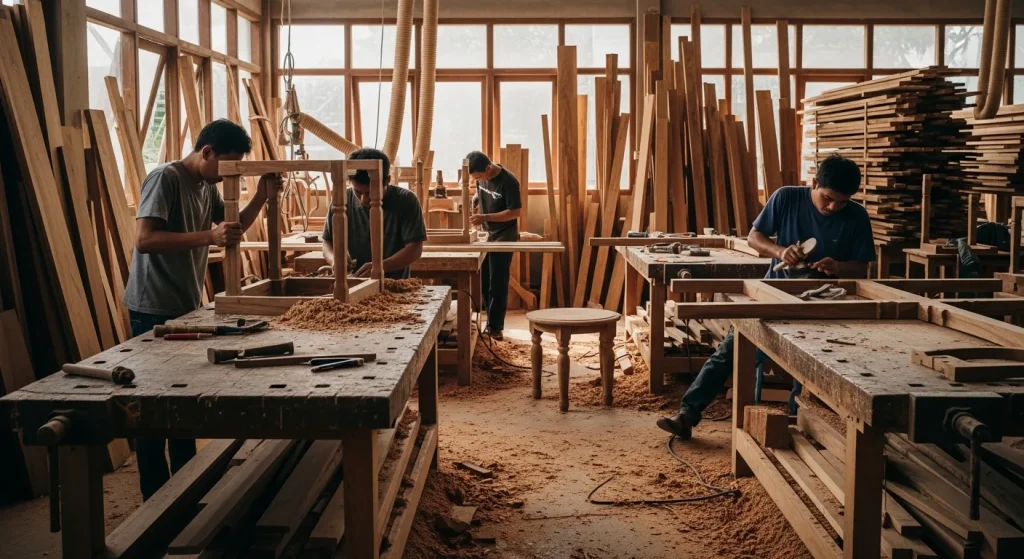
Indonesian teak furniture manufacturers are integrating advanced technologies to enhance joinery and finish quality for global buyers. This strategic adoption addresses the demand for durable, aesthetically superior products, particularly within the B2B sector. Focusing on precision and consistency, these advancements ensure that exported teak furniture meets stringent international standards.
The Evolving Landscape of Teak Furniture Manufacturing
The global teak furniture market continues to expand, with projections indicating sustained growth. Valued at USD 36.9 billion in 2026, the market is expected to reach USD 53.7 billion by 2033, demonstrating a compound annual growth rate (CAGR) of 5.5%. Another market forecast, focusing specifically on teak wood furniture, estimates a rise from USD 3.65 billion in 2025 to USD 4.84 billion by 2034, with a 4.1% CAGR. These figures, while varying due to differing market definitions, underscore a robust and expanding demand for teak products.
Indonesia’s overall furniture market also reflects this positive trend. Estimated at USD 9.1 billion in 2025, it is forecast to reach USD 15.2 billion by 2034, growing at a 5.82% CAGR. A separate assessment places Indonesia’s furniture market at USD 7.97 billion in 2025, reaching USD 10.90 billion by 2030, at a 6.46% CAGR. For Indonesia’s home furniture sector specifically, one forecast shows growth from USD 5.15 billion in 2026 to USD 6.32 billion by 2031, at a 4.19% CAGR. These statistics confirm Indonesia’s significant role in the global furniture supply chain.
Driving Factors for Technological Adoption
Several factors drive Indonesian teak furniture factories to invest in advanced manufacturing technologies:
- Global Demand for Quality: Importers, wholesalers, and trade buyers require consistent quality in joinery, finish, and structural integrity.
- Competitive Landscape: To maintain and expand market share against other global suppliers, factories must differentiate through superior product attributes.
- Efficiency and Productivity: Automation and precision machinery reduce labour costs and increase output, allowing for competitive pricing while maintaining quality.
- Sustainability Requirements: Technology aids in optimising material usage, reducing waste, and ensuring compliance with sustainability certifications like FSC and SVLK.
Advancements in Joinery Techniques
Precision joinery is fundamental to the durability and structural integrity of teak furniture. Indonesian factories are increasingly adopting sophisticated machinery and techniques to achieve superior joint quality.
Computer Numerical Control (CNC) Machining
CNC routers and other CNC machines are now integral to modern teak furniture production. These machines offer precision in cutting, shaping, and routing, which is critical for creating tight, accurate joints.
- Dovetail Joints: CNC machines can produce perfectly interlocking dovetail joints, known for their strength and resistance to pulling apart. This is particularly important for drawers and carcass construction.
- Mortise and Tenon Joints: Precision-machined mortises and tenons ensure a snug fit, eliminating gaps and enhancing the joint’s load-bearing capacity. Automated mortising machines can achieve consistent depth and width, crucial for structural stability in chairs, tables, and cabinets.
- Finger Joints: For components requiring extended lengths or where material optimisation is key, CNC-cut finger joints provide strong, reliable bonds.
The use of CNC technology minimifies human error, leading to a higher percentage of defect-free components and significantly improving overall product consistency.
Advanced Adhesives and Fasteners
While traditional joinery remains vital, modern factories also incorporate advanced adhesives and fastening systems. High-performance, waterproof wood glues are used in conjunction with precision joints to create bonds stronger than the wood itself. For outdoor furniture, adhesives with enhanced weather resistance are standard, preventing joint failure due to moisture exposure.
Innovations in Finishing Processes
The finish of teak furniture is crucial for its aesthetic appeal and protection against environmental factors. Indonesian factories are implementing new technologies to achieve superior and consistent finishes.
Automated Sanding and Polishing Systems
Manual sanding, while still present, is increasingly supplemented or replaced by automated sanding machines. These machines ensure uniform surface preparation, which is essential for an even finish application.
- Wide-Belt Sanders: For large flat panels, wide-belt sanders provide consistent thickness and smoothness.
- Orbital and Random Orbital Sanders: Automated orbital sanders handle complex curves and intricate designs, ensuring a blemish-free surface ready for finishing.
This automation reduces variations in surface quality, a common issue with purely manual processes, and prepares the wood optimally for subsequent treatments.
Electrostatic Spraying and Robotic Finishing
Application of stains, sealers, and topcoats is being revolutionised by electrostatic spraying and robotic systems.
- Electrostatic Spraying: This technique charges the finish particles, causing them to be attracted to the grounded furniture surface. This results in more even coverage, reduced overspray, and less material waste, leading to a smoother, more consistent finish.
- Robotic Arms: Programmable robotic arms can apply finishes with extreme precision and repeatability. They ensure uniform film thickness across all surfaces, eliminating streaks, drips, and inconsistent colouration often associated with manual application. This is particularly beneficial for complex furniture pieces and large production runs, guaranteeing that each unit meets the same high standard.
Advanced Curing Technologies
To expedite drying times and improve the durability of finishes, factories are utilising advanced curing technologies.
- UV Curing: Ultraviolet (UV) curing systems rapidly dry certain types of finishes, creating a hard, scratch-resistant surface. This technology is becoming more prevalent for high-traffic furniture and commercial applications where durability is paramount.
- Climate-Controlled Drying Rooms: Post-finishing, furniture is often moved into climate-controlled drying rooms to ensure optimal curing conditions. This prevents issues such as blushing, cracking, or uneven drying, which can compromise the finish’s longevity and appearance.
These innovations collectively contribute to a more resilient and aesthetically pleasing finish, extending the furniture’s lifespan and maintaining its visual integrity.
Kiln Drying and Moisture Content Management
Proper kiln drying is a prerequisite for stable teak furniture. Modern Indonesian factories employ advanced kiln-drying technologies to control moisture content precisely, a critical factor in preventing warping, cracking, and joint failure.
Automated Kiln Drying Systems
Modern kilns are equipped with sophisticated sensors and computerised controls that monitor temperature, humidity, and airflow throughout the drying cycle. This automation ensures optimal drying schedules for different teak grades and thicknesses, reducing drying defects and achieving uniform moisture content.
A 2027 note: Indonesian teak exporters are increasingly investing in next-generation kiln-drying facilities, recognising that precise moisture content (typically 8-12% for export) is non-negotiable for grade A teak outdoor furniture supplier products destined for diverse global climates, directly impacting product stability and customer satisfaction.
Moisture Meters and Quality Control
Throughout the production process, from rough timber to finished product, digital moisture meters are used to verify moisture content. This continuous monitoring ensures that components meet specified moisture levels before assembly and finishing, thereby guaranteeing product stability.
Quality Assurance and Certification
The integration of technology extends to quality assurance. Factories are implementing more rigorous inspection protocols, often using digital tools for measurement and defect detection. Additionally, adherence to certifications like SVLK (Sistem Verifikasi Legalitas Kayu) and FSC (Forest Stewardship Council) is facilitated by improved traceability systems, often digitally managed.
The average global teak wood furniture price was approximately USD 500 per unit in 2025, based on roughly 8 million units sold globally. This average masks significant variation based on factors such as teak grade, FSC/SVLK documentation, kiln-drying quality, joinery, finish, and order volume. Certified, export-ready products, particularly from a grade A teak outdoor furniture supplier, consistently command a premium.
| Factor | Impact on Quality | Technological Advancement |
|---|---|---|
| Joinery Strength | Prevents structural failure, enhances durability | CNC machining, automated mortising/tenoning |
| Finish Consistency | Ensures uniform appearance, protects wood | Robotic finishing, electrostatic spraying, UV curing |
| Moisture Stability | Prevents warping, cracking, joint separation | Automated kiln drying, digital moisture meters |
| Material Utilisation | Reduces waste, improves cost-efficiency | CAD/CAM software, optimised cutting patterns |
| Traceability | Verifies legal and sustainable sourcing | Digital inventory and certification management |
These technological investments position Indonesian teak furniture manufacturers as reliable suppliers of high-quality products to the global market, particularly for importers, wholesalers, and trade buyers seeking durable and aesthetically superior teak outdoor furniture.
For further information or to discuss your specific requirements, request a wholesale quote on WhatsApp.